
Any links on this page that lead to products on Amazon and other companies may be affiliate links and we earn a commission if you make a qualifying purchase. Thanks in advance for your support!
What causes acid reflux? Acid reflux is caused by the lower esophageal sphincter (LES), the ring of muscle at the top of the stomach, relaxing or weakening so that stomach acid flows back up into the esophagus. The most common causes are a hiatal hernia, being overweight, pregnancy, smoking, large or late meals, certain foods and drinks, and some medicines.
Last reviewed: November 2026
Key Takeaways
- Reflux happens when the valve between your esophagus and stomach doesn’t close properly.
- There’s no single cause. Hiatal hernia, extra weight, pregnancy, smoking, late meals and some medicines are the most common.
- The best evidence supports losing excess weight, not eating 2–3 hours before bed, raising the head of your bed and stopping smoking.
- Cutting out long lists of “trigger foods” has little evidence. Find and avoid your own triggers instead.
- See a doctor if you have heartburn most days for 3 weeks or more, or trouble swallowing, frequent vomiting or unexplained weight loss.
So what causes acid reflux in you? That’s the million-dollar question. You’ve probably seen endless lists of “trigger foods”, “reflux diets” and physical causes such as a hiatal hernia or even a tight waistband. The truth is that there is no single cause. Most people with the condition have their own mix of reasons, so each of us has to find our own triggers and remedies, while learning from the common factors that others share.
What Happens in Your Body During Acid Reflux?
Whatever the underlying reason, the main culprit is the lower esophageal sphincter (LES). It’s a ring of muscle at the bottom of the esophagus (the tube that carries food from your mouth to your stomach), and it acts as a door into the stomach.
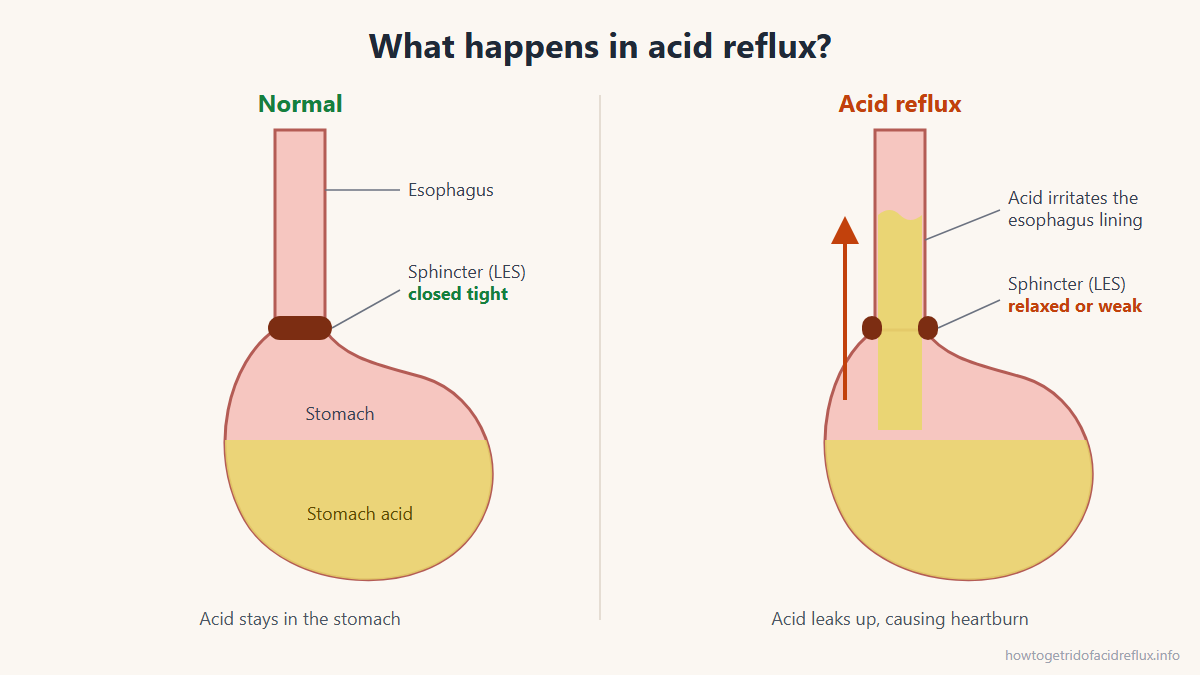
Normally this door opens briefly to let food through and then closes tightly. With heartburn and acid reflux it either relaxes when it shouldn’t, or it’s too weak to stay shut. Stomach acid, which is strong enough to break down food, then leaks upwards and irritates the lining of the esophagus. That’s the burning feeling we all know too well.
If this happens regularly, doctors call it gastroesophageal reflux disease, or GERD (GORD in the UK). The US National Institute of Diabetes and Digestive and Kidney Diseases has a clear overview if you’d like more detail.
What Are the Most Common Causes of Acid Reflux?
There are many reasons the LES might misbehave. These are the ones most often recognised by doctors and health bodies such as the NHS:
- A weak or relaxed sphincter. Sometimes the LES simply doesn’t close as firmly as it should.
- Hiatal hernia. Part of the stomach pushes up through the diaphragm, which makes it easier for acid to escape. The NHS explains this well on its hiatus hernia page.
- Being overweight. Extra weight around the middle puts pressure on the stomach. Losing weight is one of the few lifestyle changes with good evidence behind it. A large Norwegian study that followed nearly 30,000 people found that those who lost weight were more likely to see their reflux reduce or disappear.
- Pregnancy. Hormones relax the LES and the growing baby presses on the stomach. The NHS has advice on heartburn in pregnancy, and there’s more in my post on weight, gluten and pregnancy.
- Slow stomach emptying (gastroparesis). Food stays in the stomach longer, so there’s more opportunity for reflux.
- Certain medicines. These include some anti-inflammatory painkillers (such as ibuprofen), some blood pressure medicines (calcium channel blockers), nitrates, some asthma medicines, and bisphosphonates for osteoporosis, which can irritate the esophagus directly (review of drugs linked to GERD). Never stop a prescribed medicine without talking to your doctor or pharmacist first.
- Lifestyle. Smoking, alcohol, big meals, eating late in the evening and lying down soon after eating all make reflux more likely. A 2022 study concluded that “conservative measures, including dietary modifications such as reducing the consumption of alcohol, caffeine, and chocolate, behavioral changes such as smoking cessation and elevation of the head of the bed, and weight loss, should be used as first-line management for GERD”. See also my posts on smoking and chewing tobacco and fatty foods.
Which Foods Trigger Acid Reflux?
The usual suspects are peppermint, tomatoes, citrus, chocolate, spicy food, fatty or fried food, coffee, alcohol and fizzy drinks. Meal size matters too. One source I read suggested meals should be no bigger than your fist!
Here’s the thing, though. Much of this comes from what sufferers report rather than from solid clinical trials. A review of the evidence on lifestyle measures found little proof that cutting out trigger foods helps everyone, but there was physiologic evidence that exposure to tobacco, alcohol, chocolate, and high-fat meals can relax the LES, so it could help some. The key is to try cutting out individual foods to see if it works for you. On the other hand there is good evidence that weight loss (if you are overweight) and raising the head of the bed works for a wider group of people.
How Can You Reduce Acid Reflux?
The latest American College of Gastroenterology guideline (2022) doesn’t tell everyone to cut out a long list of foods. Instead it recommends:
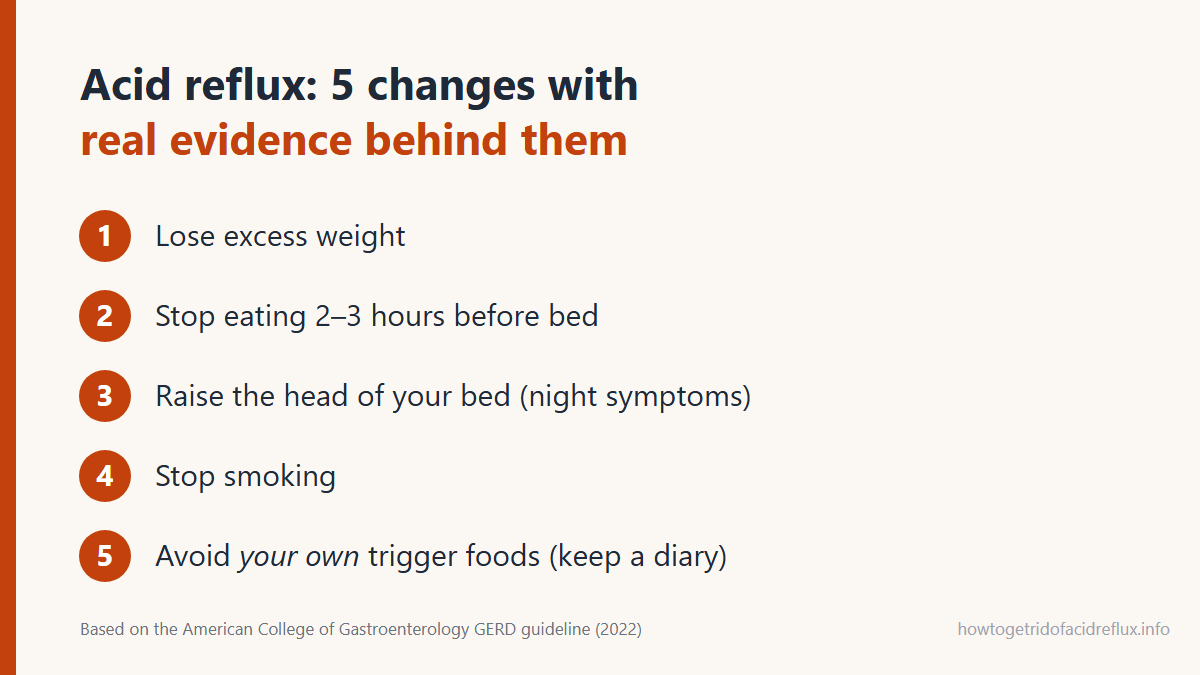
- Losing excess weight, if you’re overweight (see the weight-loss study above).
- Not eating for two to three hours before bed. A Japanese study found that people who ate dinner less than three hours before going to bed were much more likely to have reflux.
- Raising the head of your bed if you get symptoms at night. A systematic review found this can help, although the studies were small. A wedge pillow is an easy way to do it.
- Stopping smoking. In the same Norwegian population study, people of normal weight who quit smoking saw their reflux improve.
- Avoiding the foods that trigger your symptoms, rather than everything on someone else’s list.
So the most useful approach is to experiment as systematically as you can. Keep a simple food and symptom diary and remove one suspect at a time (not all at once, or you may find you have a more drastic problem than acid reflux!).
Can Low Stomach Acid Cause Acid Reflux?
One theory with a small but loyal following is that some people get reflux because they have too little stomach acid, not too much. It sounds back to front, and to be honest the scientific evidence for it is thin. But it comes up a lot, so I’ve looked into it in more detail in Low Stomach Acid: Does This Cause Acid Reflux?
When Should You See a Doctor About Acid Reflux?
Occasional heartburn is very common and usually harmless. The NHS advises seeing a GP if:
- lifestyle changes and pharmacy medicines aren’t helping
- you have heartburn most days
- you have other symptoms, such as food getting stuck in your throat, being sick often, or losing weight for no reason
Persistent reflux can damage the esophagus over time, so it’s worth getting checked rather than putting up with it.
Frequently Asked Questions
What is the main cause of acid reflux?
The main cause is a lower esophageal sphincter (LES) that relaxes at the wrong time or is too weak to close properly, letting stomach acid escape into the esophagus. Things that make this more likely include a hiatal hernia, excess weight, pregnancy, smoking and eating large meals late at night.
Is acid reflux caused by too much stomach acid?
Usually not. Most people with reflux produce a normal amount of acid. The problem is that acid ends up in the wrong place because the valve at the top of the stomach doesn’t close properly.
What is the difference between acid reflux, heartburn and GERD?
Acid reflux is stomach acid flowing back into the esophagus. Heartburn is the burning feeling in the chest that it often causes. GERD (GORD in the UK) is the name for reflux that happens regularly or causes troublesome symptoms or damage.
Can stress cause acid reflux?
Stress isn’t thought to directly cause reflux, but many people find it makes their symptoms feel worse. It can also lead to habits that trigger reflux, such as eating late, smoking or drinking more alcohol.
How do I find out what triggers my acid reflux?
Keep a simple diary of what you eat and drink, when you eat, and when symptoms appear. After a couple of weeks, look for patterns, then cut out one suspect at a time to see if it makes a difference.
References
- Katz PO, Dunbar KB, Schnoll-Sussman FH, et al. ACG Clinical Guideline for the Diagnosis and Management of Gastroesophageal Reflux Disease. Am J Gastroenterol. 2022.
- Ness-Jensen E, et al. Weight loss and reduction in gastroesophageal reflux: the HUNT study. Am J Gastroenterol. 2013.
- Ness-Jensen E, et al. Tobacco smoking cessation and improved gastroesophageal reflux: the HUNT study. Am J Gastroenterol. 2014.
- Fujiwara Y, et al. Association between dinner-to-bed time and gastro-esophageal reflux disease. Am J Gastroenterol. 2005.
- Albarqouni L, et al. Head of bed elevation to relieve gastroesophageal reflux symptoms: a systematic review. BMC Fam Pract. 2021.
- Kaltenbach T, Crockett S, Gerson LB. Are lifestyle measures effective in patients with gastroesophageal reflux disease? An evidence-based approach. Arch Intern Med. 2006.
- Which drugs are risk factors for the development of gastroesophageal reflux disease? Turk J Gastroenterol. 2017.
- NHS. Heartburn and acid reflux.
- NIDDK. Symptoms and causes of GER and GERD.
This article is for general information and isn’t a substitute for advice from your doctor or pharmacist.